GENE VISualization for Integrated Biological Landscape Exploration

Exploring Gene Expression Through Integrated Biological Perspectives
Biological systems are shaped by complex molecular interactions, coordinated regulatory mechanisms, and dynamic patterns of gene activity. Understanding these processes requires more than the identification of individual genes. It involves examining how genetic information is expressed, how molecular pathways interact, and how cellular functions evolve across tissues, developmental stages, and environmental conditions.
GENE VISualization for Integrated Biological Landscape Exploration is a scientific concept dedicated to the exploration of gene expression, molecular relationships, and the biological patterns underlying complex living systems. By connecting genomic information with transcriptomic analysis and computational interpretation, this platform highlights the importance of integrated approaches to understanding biological organization.
Gene expression provides an essential link between genetic information and cellular activity. Variations in transcription can reveal differences in cell identity, physiological responses, developmental processes, and molecular adaptation. Through systematic investigation of these variations, researchers can develop a more comprehensive understanding of the mechanisms that shape biological diversity and function.
Our approach emphasizes the interpretation of molecular information within its broader biological context, bringing together gene expression profiling, transcriptomic exploration, computational biology, and systems-level perspectives.
From Molecular Signals to Biological Meaning
Every biological system contains layers of information that contribute to its structure, function, and adaptability. Gene expression patterns represent one of the most informative layers because they reflect how cells use their genetic resources under specific conditions.
Differences in transcriptional activity may distinguish healthy and altered tissues, reveal developmental transitions, or indicate cellular responses to external stimuli. However, these molecular differences must be interpreted carefully, considering biological variability, experimental design, sample characteristics, and the relationships between individual genes.
The exploration of gene expression therefore involves several complementary dimensions:
Identification of transcriptional patterns across biological samples.
Comparison of expression profiles between experimental conditions.
Investigation of genes associated with particular cellular functions.
Exploration of regulatory relationships and molecular pathways.
Integration of transcriptomic observations with functional biological knowledge.
Interpretation of complex datasets through computational and statistical approaches.
By examining these dimensions together, researchers can move beyond isolated molecular measurements and investigate the broader organization of biological information.
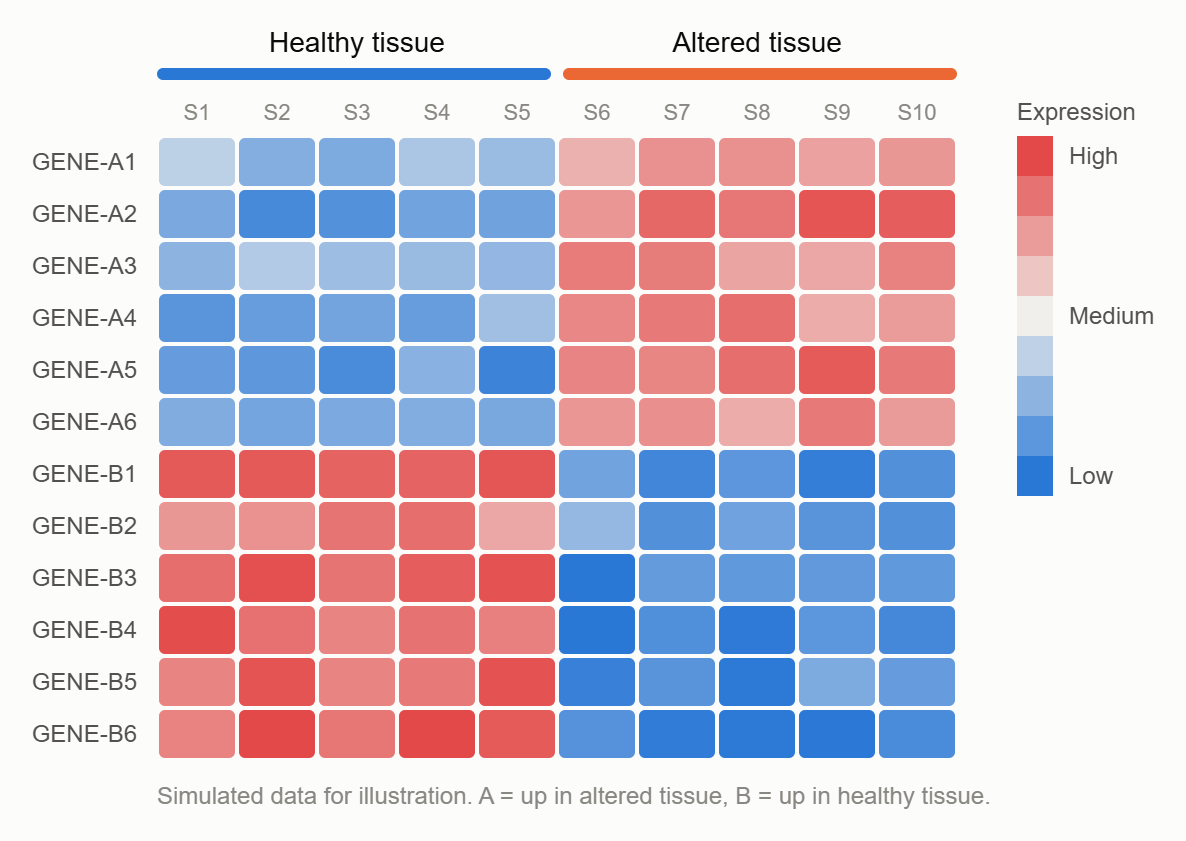

Gene Expression as a Window into Cellular Organization
Cells possess the same fundamental genetic information in many biological contexts, yet they can perform remarkably different functions. Their identities and activities are influenced by the selective regulation of genes, the availability of regulatory molecules, and the surrounding cellular environment.
Gene expression analysis helps explain these differences by examining which genes are active, how strongly they are expressed, and how their activity changes under different circumstances. These observations provide valuable perspectives on cellular differentiation, tissue specialization, physiological adaptation, and disease-associated molecular alterations.
The interpretation of expression profiles also helps researchers identify coordinated groups of genes. Such groups may participate in shared biological processes, respond to similar regulatory signals, or reflect changes in the composition of a tissue.
Understanding these relationships is essential for investigating biological complexity. Rather than considering genes as independent units, an integrated perspective examines how their expression patterns contribute collectively to cellular behavior.
Transcriptomic Exploration and Data Interpretation
Transcriptomics investigates the RNA molecules produced by biological systems and provides a broad view of transcriptional activity. Advances in sequencing technologies and computational methods have substantially expanded the possibilities for characterizing gene expression across thousands of genes simultaneously.
Large-scale transcriptomic datasets can reveal molecular signatures that are difficult to detect through the analysis of individual genes. They can also support comparisons between tissues, developmental stages, experimental treatments, and environmental conditions.
Effective transcriptomic interpretation requires several interconnected analytical steps, including data quality assessment, normalization, statistical comparison, expression pattern identification, and biological annotation. Each step contributes to the reliability and interpretability of the resulting observations.
Important areas of exploration include:
Differential gene expression and transcriptional variation.
RNA sequencing data analysis and interpretation.Learn more
Gene expression matrices and sample-level comparisons.
Functional enrichment and biological process annotation.
Molecular signatures associated with specific phenotypes.
Gene co-expression patterns and regulatory hypotheses.
Integration of transcriptomic findings with other biological datasets.
Combining these methods enables researchers to investigate not only which genes change their expression, but also which biological processes may be associated with those changes.
Mapping the Biological Landscape of Gene Activity
Gene expression data can be understood as a multidimensional biological landscape in which genes, samples, tissues, and experimental conditions represent interconnected sources of information.
Visualization techniques help transform complex datasets into interpretable representations. Expression heatmaps, clustering diagrams, dimensionality-reduction plots, correlation matrices, and pathway networks can reveal structures that may remain difficult to recognize in raw numerical tables.
These visual representations serve different analytical purposes. Heatmaps can highlight similarities among expression profiles, clustering methods can group samples according to molecular patterns, and network representations can illustrate relationships between genes or biological functions.
The value of visualization extends beyond presentation. It can support exploratory analysis, facilitate the identification of unusual observations, and help researchers formulate questions for subsequent investigation.
Meaningful visualization must nevertheless remain grounded in appropriate statistical methods and biological interpretation. Patterns observed in a graph should be evaluated in light of data quality, sample size, experimental conditions, and the limitations of the analytical approach.
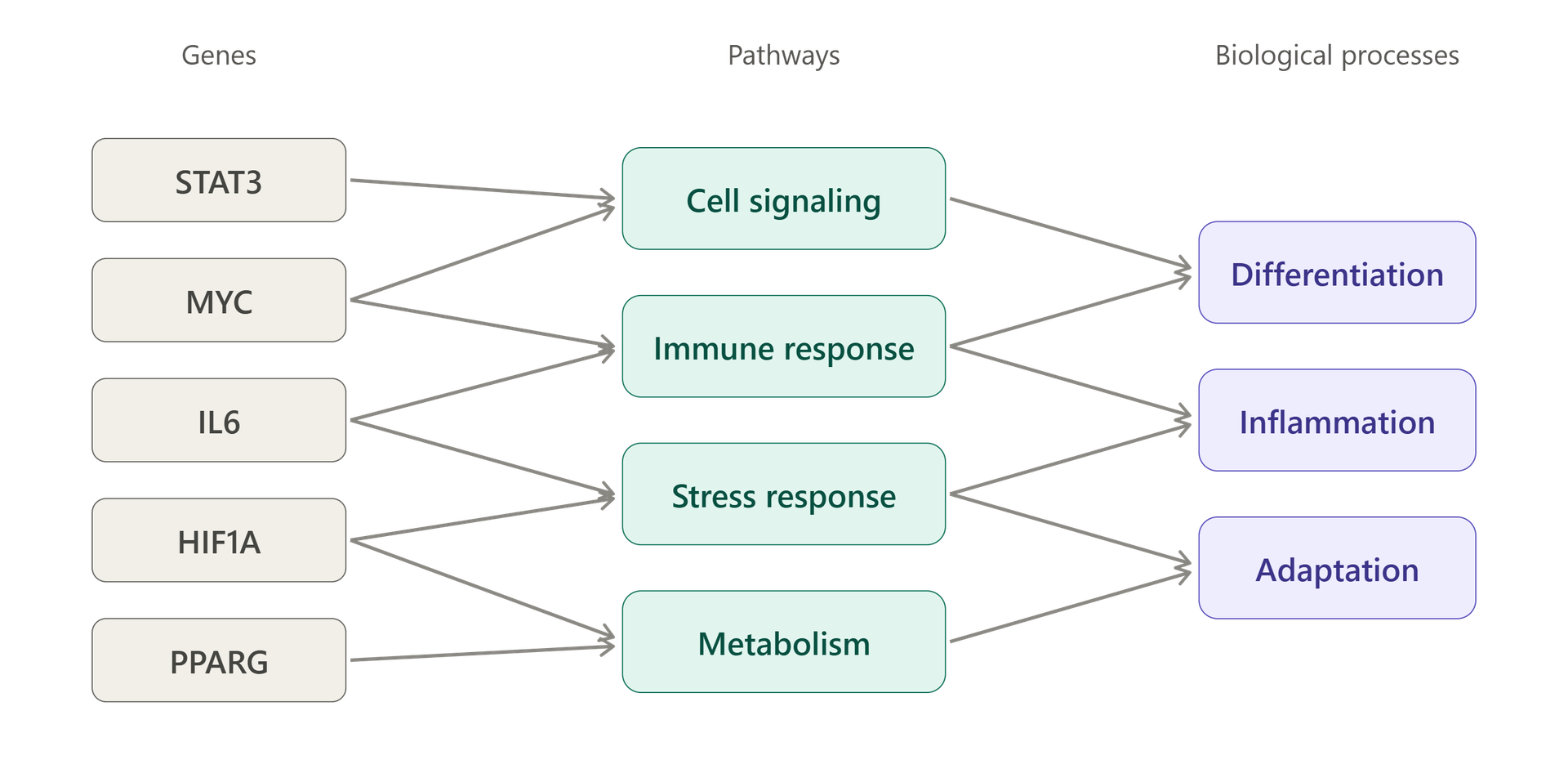
Connecting Genes, Pathways, and Biological Processes
The biological effects of gene expression frequently emerge from the coordinated activity of multiple molecular components. Genes participate in signaling pathways, metabolic processes, cellular structures, and regulatory networks that collectively contribute to biological function.
Pathway-oriented interpretation provides a framework for organizing gene-level observations into broader functional categories. When multiple genes associated with a particular process display coordinated expression changes, their combined pattern may offer clues about the biological mechanisms involved.
Functional enrichment analysis, pathway annotation, and interaction-network exploration can help investigate these relationships. Such methods provide opportunities to connect transcriptomic measurements with existing biological knowledge and identify processes that merit further examination.
Relevant areas include cellular signaling, transcriptional regulation, metabolism, stress responses, cell differentiation, immune-associated processes, and mechanisms of cellular adaptation.
These associations should be interpreted as evidence to investigate rather than automatic proof of causality. Additional experiments and independent validation may be necessary to establish the functional significance of a proposed molecular relationship.
Computational Biology and Intelligent Data Exploration
The growing scale of biological datasets has increased the importance of computational methods capable of organizing, comparing, and interpreting molecular information.
Bioinformatics combines biological knowledge with statistical analysis, algorithm development, and data-management strategies to investigate complex molecular systems. In gene expression research, these approaches support the processing of transcriptomic measurements, the identification of expression signatures, and the integration of information from different biological sources.
Machine learning and artificial intelligence can extend these capabilities by helping researchers detect complex patterns, organize high-dimensional data, and generate hypotheses for further investigation.
Potential applications include sample classification, molecular signature discovery, expression-based clustering, predictive modeling, and the prioritization of candidate genes for experimental follow-up.
The reliability of these applications depends on appropriate training data, transparent analytical procedures, independent validation, and careful consideration of potential biases. Computational predictions should complement biological expertise rather than replace experimental evidence.

Exploring Gene Regulation and Molecular Relationships
Gene expression is controlled by multiple regulatory mechanisms operating at different levels. Transcription factors, regulatory DNA elements, chromatin organization, epigenetic modifications, RNA processing, and RNA stability can all influence the abundance and activity of gene transcripts.
Investigating these mechanisms helps researchers understand why expression levels differ between biological contexts and how cells coordinate complex responses.
Comparative expression analysis can identify candidate genes whose activity changes alongside a biological condition. When combined with regulatory information, these observations may support the development of hypotheses concerning upstream regulators, transcriptional programs, and potential molecular interactions.
Co-expression analysis offers another perspective by identifying genes that display similar expression patterns across samples. Such relationships can suggest shared regulation or functional association, although correlation alone does not establish a direct regulatory interaction.
An integrated investigation therefore benefits from combining expression measurements with complementary evidence, including genomic annotations, functional databases, regulatory information, and experimentally supported molecular relationships.

Transcription factors.

epigenetic modifications

regulatory DNA elements

Integrating Multi-Omics Information
Gene expression represents an important component of biological information, but it does not independently capture every aspect of cellular function. Transcript abundance may not directly reflect protein abundance, protein activity, or the concentration of individual metabolites.
Multi-omics approaches address this complexity by integrating complementary layers of molecular information. Transcriptomics can be combined with genomics, epigenomics, proteomics, metabolomics, and other analytical disciplines to explore biological systems from multiple perspectives.
Such integration may help researchers investigate how genetic variation influences transcription, how regulatory mechanisms shape molecular activity, and how changes in gene expression relate to downstream biochemical processes.
Computational integration requires attention to differences in measurement scale, data quality, sample composition, and experimental design. Appropriate statistical frameworks are essential for distinguishing meaningful biological relationships from technical variation.
By connecting complementary datasets, researchers can develop broader hypotheses about biological mechanisms while recognizing that each analytical layer provides only a partial representation of the underlying system.
From Molecular Discovery to Biomedical Research
Gene expression analysis has become an important component of research across molecular biology, biotechnology, biomedical sciences, and translational investigation.
In biomedical research, expression profiles can help characterize molecular differences associated with disease, explore cellular responses to experimental interventions, and identify candidate biomarkers for further validation.
In pharmaceutical research, transcriptomic approaches can contribute to the investigation of treatment-associated molecular changes, the characterization of cellular responses, and the exploration of mechanisms potentially associated with therapeutic activity.
In biotechnology, gene expression information can support the study of engineered biological systems, the evaluation of production processes, and the investigation of molecular responses under controlled conditions.
These applications depend on the scientific question, the quality of the available data, and the suitability of the analytical design. Observed expression differences should not automatically be interpreted as diagnostic markers, validated therapeutic targets, or evidence of clinical effectiveness.
The objective is to generate interpretable molecular evidence that can inform further research and support appropriately designed experimental investigations.

Research Methodologies and Analytical Perspectives
A comprehensive investigation of gene expression requires a structured analytical framework. The selection of appropriate methods depends on the research objective, the characteristics of the biological material, and the type of molecular data available.
Different approaches provide complementary forms of evidence.
Quantitative gene expression analysis examines the abundance of selected transcripts using targeted techniques such as quantitative polymerase chain reaction. These methods are useful when investigating specific genes or validating observations obtained through broader analyses.
RNA sequencing provides information about transcript abundance across a wide range of genes and, depending on the experimental design and analytical workflow, can support additional transcript-level investigations.
Differential expression analysis identifies genes whose measured expression differs between defined groups while accounting for statistical uncertainty and relevant experimental factors.
Functional annotation connects genes with biological processes, molecular functions, and cellular components, helping researchers interpret large lists of molecular observations.
Network analysis investigates relationships among genes, proteins, pathways, and regulatory components to explore the organization of biological systems.
Data visualization supports the exploration and communication of complex molecular patterns through graphical representations adapted to the underlying question.
The combination of these methodologies enables a more complete interpretation of molecular datasets than reliance on a single analytical technique.
An Integrated Perspective on Molecular Discovery
The exploration of gene expression is most informative when molecular measurements are connected with biological context, computational interpretation, and experimental evidence.
GENE VISualization for Integrated Biological Landscape Exploration embraces this integrated perspective by bringing attention to the relationships between transcriptional activity, cellular organization, molecular pathways, and biological function.
Through the combination of transcriptomic analysis, gene expression visualization, functional annotation, and systems-oriented investigation, complex datasets can become more accessible to scientific interpretation.
The objective is not simply to display molecular information, but to encourage meaningful questions about how biological systems operate, how their molecular patterns change, and how these changes can be investigated through reproducible research.
As analytical technologies continue to evolve, integrated gene expression exploration will remain an important component of efforts to understand biological complexity at molecular, cellular, and systems levels.